ACSM Guidelines vs. Generic Workout Plans: What's the Difference?
When it comes to exercise, there's a world of difference between following a generic plan and working with the ACSM guidelines for exercise testing and prescription.
You've seen them everywhere—those "perfect" workout plans promising six-pack abs in 30 days.
They look credible. They've got fancy names and rep schemes. But here's what they don't tell you: they weren't designed for you.
The American College of Sports Medicine (ACSM) has spent decades developing the gold standard in exercise science. Their guidelines for exercise testing and prescription aren't just suggestions—they're evidence-based protocols built on data from thousands of participants.
And the latest 2026 update just reinforced something important: consistency beats complexity, but personalization still matters .
Let's break down the real differences.
What Makes ACSM Guidelines Different?
The ACSM guidelines for exercise testing and prescription are the foundation of legitimate exercise science. Now in its 12th edition, this handbook delivers scientifically based standards that professionals use to design safe, effective programs .
What sets it apart?
It's evidence-based, not trend-based. Every recommendation comes from peer-reviewed research.
The latest update synthesized findings from 137 systematic reviews with over 30,000 participants
It considers the whole person. These guidelines for exercise testing and prescription account for age, health status, goals, and medical history. They're designed to be modified based on an individual's physical function and exercise responses
It's updated with the latest science. The 2026 Position Stand—the first major update since 2009—introduced significant changes based on new research, including updated guidance on resistance training and behavioral strategies .
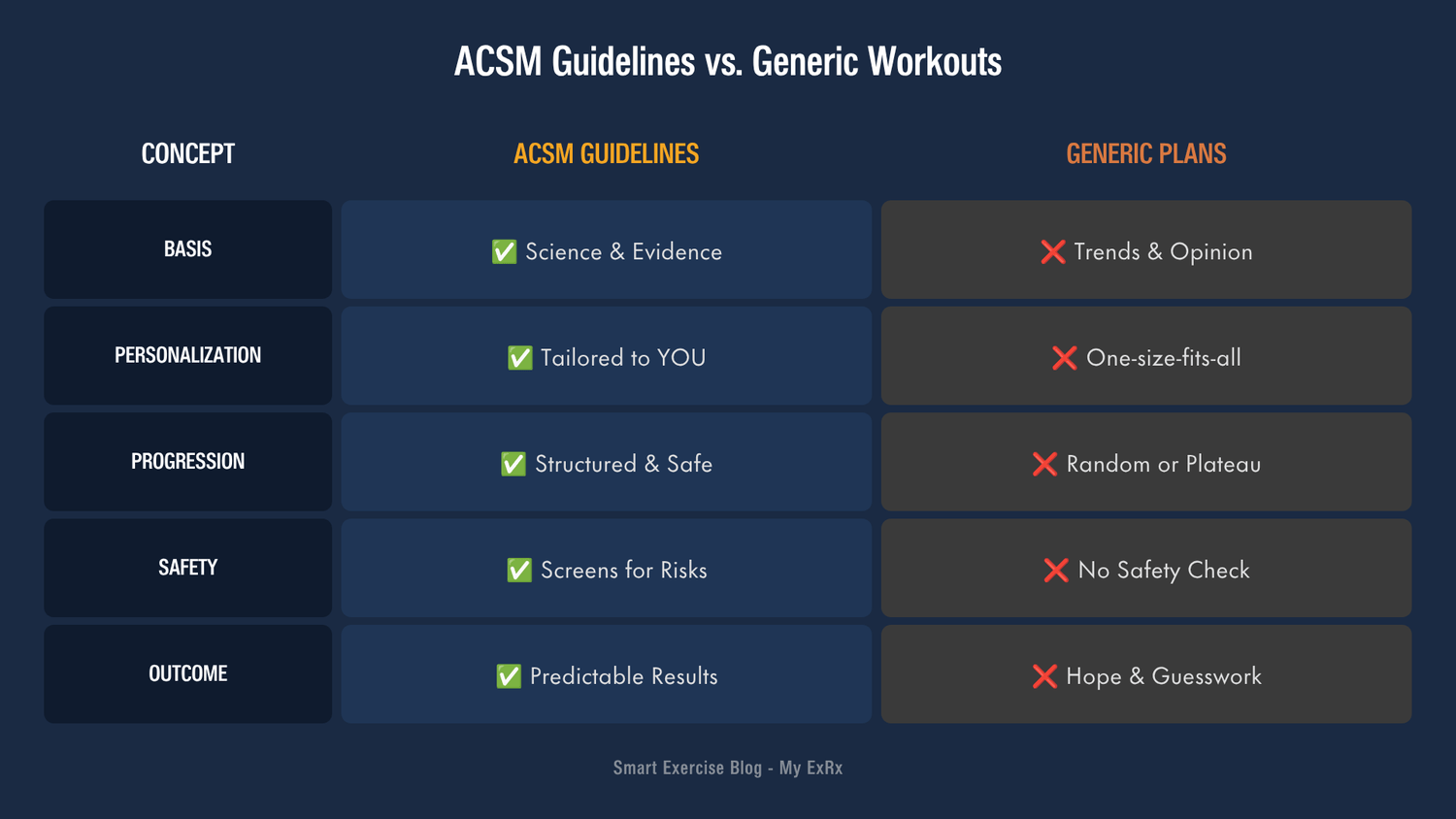
Generic Workout Plans: The Appeal and The Problem
Generic plans are everywhere because they're easy. Type "home workout" into any search engine and you'll get thousands of options. They look simple.
They're free. And for some people, they work for a while.
But here's where they fall short:
One size fits none. A plan designed for the "average" person doesn't account for your metabolic rate, recovery capacity, injury history, or hormonal status. You're not average—you're unique.
No progression strategy. Most generic plans tell you what to do today but not how to safely advance next month. Without a progression plan, you plateau or, worse, get injured.
Safety isn't guaranteed. Generic plans can't screen for contraindications or warning signs.
The ACSM guidelines for exercise testing and prescription emphasize that exercise programs should be modified according to health status and exercise responses—something no generic plan does
The 2026 ACSM Update: What Changed?
The ACSM just released its most significant update in 17 years, and the message is refreshing: you don't need a complicated plan to get results.
Here's what the new guidelines for exercise testing and prescription emphasize:
Consistency beats complexity. "The best resistance training program is the one you'll actually stick with," says Dr. Stuart Phillips, lead author on the Position Stand . Training all major muscle groups at least twice a week matters more than chasing the idea of a "perfect" plan
.
Individualization matters more than rigid rules. The guidelines explicitly move away from one-size-fits-all prescriptions. Programs should be tailored to personal goals, enjoyment, and safety.
Nontraditional training works. You don't need a gym. Bodyweight exercises, resistance bands, and home-based routines yield marked benefits in strength and physical function .
Advanced techniques are often optional. Training to failure, complex periodization, and specific equipment choices don't consistently impact outcomes for the average healthy adult .
What This Means For Your Home Exercise Routine
The new ACSM findings are encouraging: you don't need to overthink your workouts. Just start and be consistent.
But—and this is crucial—the guidelines still emphasize that programs should be individualized. The general principles are clear, but applying them to your specific body, goals, and limitations requires more than a generic template.
A real exercise prescription based on ACSM standards includes:
Frequency: Exactly how many days per week based on your capacity
Intensity: Precise effort levels tailored to your fitness
Time: Specific session duration that matches your needs
Type: Movements chosen for your body and goals
Progression: When and how to safely advance
Generic plans give you guesses. ACSM-aligned prescriptions give you precision.
The Bottom Line
Generic workout plans aren't useless—they can get you moving, which is the first step . But to get sustained results safely, the ACSM guidelines for exercise testing and prescription offer a proven framework that generic plans simply can't match.
The latest evidence from ACSM makes one thing clear: the best program is one you'll actually do consistently. And the best way to ensure consistency? A program that's designed for your body, your goals, and your life.
Choose ACSM-aligned precision with My ExRx. Get an exercise prescription designed specifically for you—no guesses, no generic templates. Just data-driven, personalized plans that work.
Did you like this article? Spread the word!


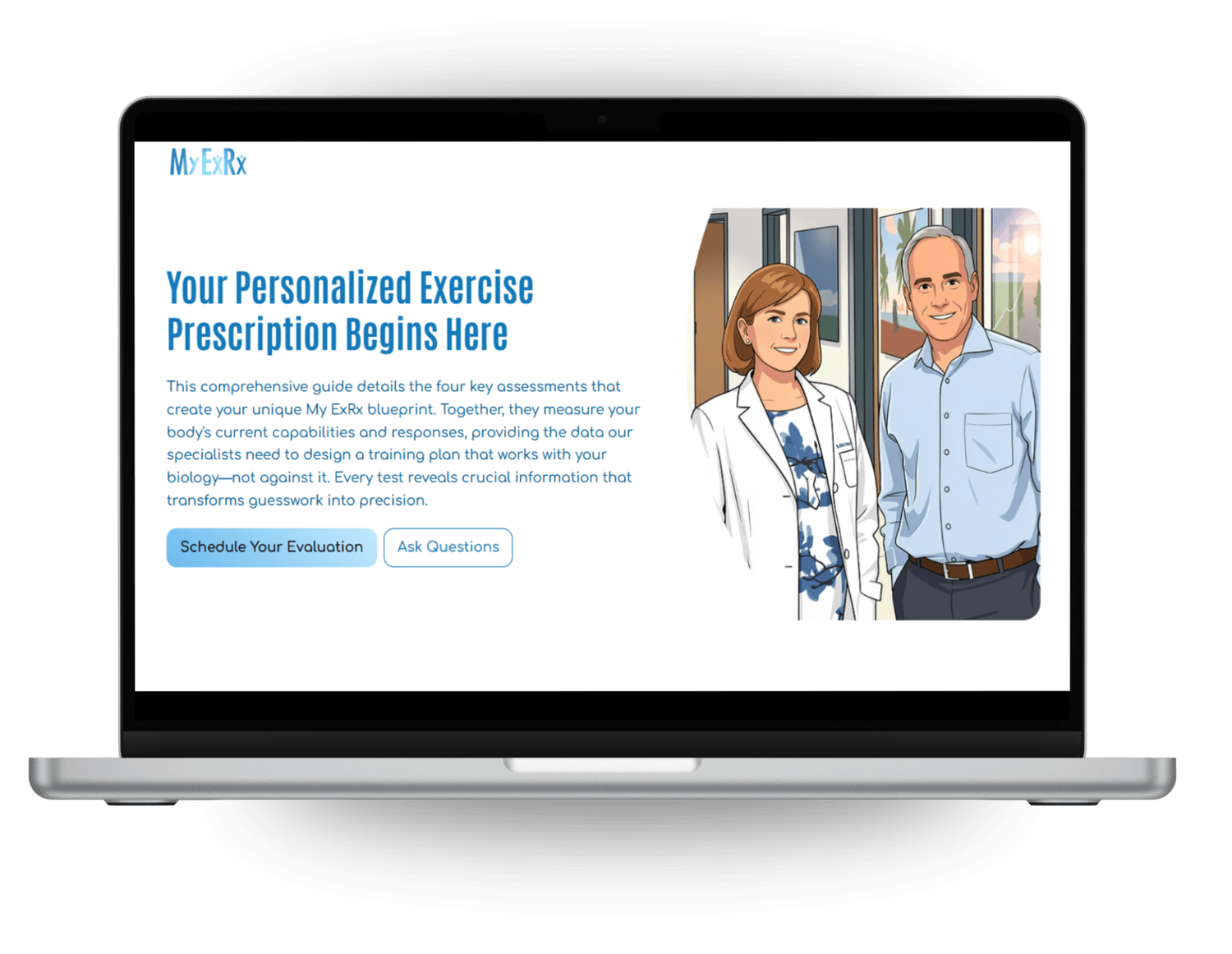
Learn all about
My ExRx Exercise Prescription!
Every test, every biomarker, and every benefit so you know exactly what to expect.
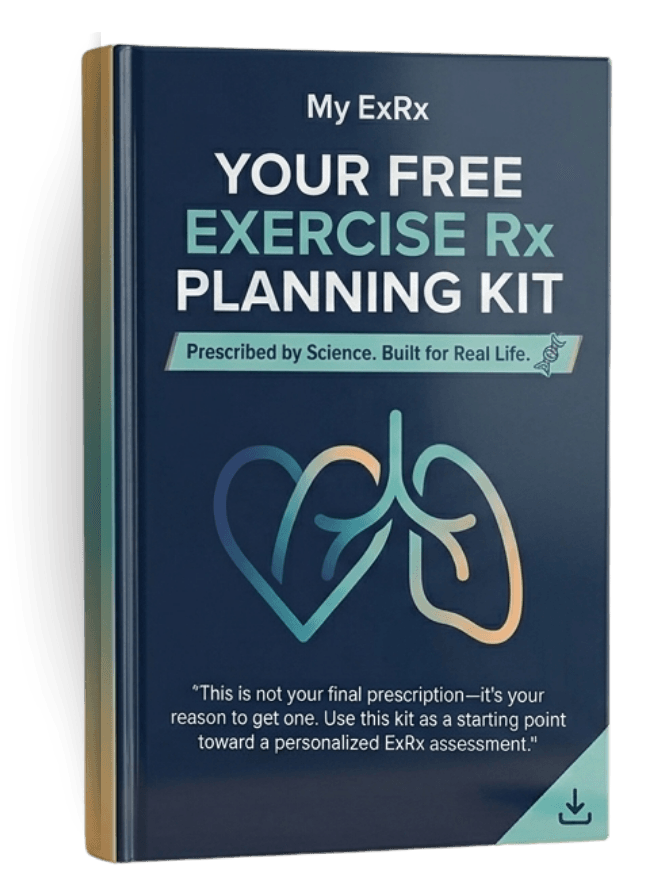
Download Your Free Exercise Prescription Planning Kit
Featuring an estimated intensity guide, a science-backed Habit Loop Tool, a weekly progress tracker, and more.
Your smart starting point before a personalized ExRx evaluation.
Download Your Free Exercise Prescription Planning Kit
Featuring an estimated intensity guide, a science-backed Habit Loop Tool, a weekly progress tracker, and more.
Your smart starting point before a personalized ExRx evaluation.
Exercise Prescription in Miami Beach, FL. Smart Exercise explores VO₂ max, nutrition, longevity, and more.

